


Imagine your team operating at peak efficiency, leveraging the power of advanced artificial intelligence directly within your daily chat. That’s the reality with Claude Code For Slack. This integration transforms your Slack workspace into an intelligent hub, enabling seamless interaction with a powerful AI collaborator, supercharging your team’s productivity.
Unlock new levels of creativity and problem-solving, automate mundane tasks, generate fresh ideas, and get instant answers without ever leaving your team chat environment. Integrating Claude with Slack isn’t just an upgrade; it’s a fundamental shift in how your team collaborates and achieves its goals. Ready to redefine productivity? Let’s explore how this potent integration empowers your entire organization.
- Understanding Claude AI’s Capabilities for Business
- Why Integrate Claude with Your Slack Workspace?
- Official Channels to Access Claude for Slack
- Exploring Custom and Unofficial Integration Approaches
- Prerequisites for Developing a Slack Bot with Claude
- Step-by-Step Guide: Setting Up Your Claude Bot
- Creating a New Slack App for Your Integration
- Configuring Scopes and Permissions for Your Claude Code
- Handling Event Subscriptions and Webhooks
- Writing the Core Claude Code For Slack Interaction
- Interacting with Anthropic’s Claude API
- Processing Slack Messages and Generating Responses
- Deploying Your Claude Code For Slack: Hosting Solutions
- Key Use Cases for Leveraging Claude in Slack Teams
- Best Practices for Team Adoption and Management
- Troubleshooting Common Claude Integration Issues
- Security and Data Privacy Considerations for AI Bots
- Customizing Claude’s Responses and Functionality
- Comparing Claude Integration with Other AI Tools in Slack
- The Future of AI-Powered Communication in Workspaces
- Frequently Asked Questions
Understanding Claude AI’s Capabilities for Business
Claude AI excels at complex reasoning, robust language understanding, and nuanced interaction. It handles a vast array of tasks, from drafting elaborate reports to brainstorming creative marketing campaigns. Its ability to process extensive context means it retains a deep understanding of ongoing conversations and project details.
Businesses value Claude for its commitment to helpful, harmless, and honest interactions. This focus on responsible AI ensures reliable and trustworthy outputs for critical business functions. It’s a powerful ally for information retrieval, content generation, and sophisticated analytical tasks.
Think of Claude as a dedicated, tireless assistant ready to support your team’s most challenging demands. Its versatility makes it invaluable across various departments, from customer support to software development.
Why Integrate Claude with Your Slack Workspace?
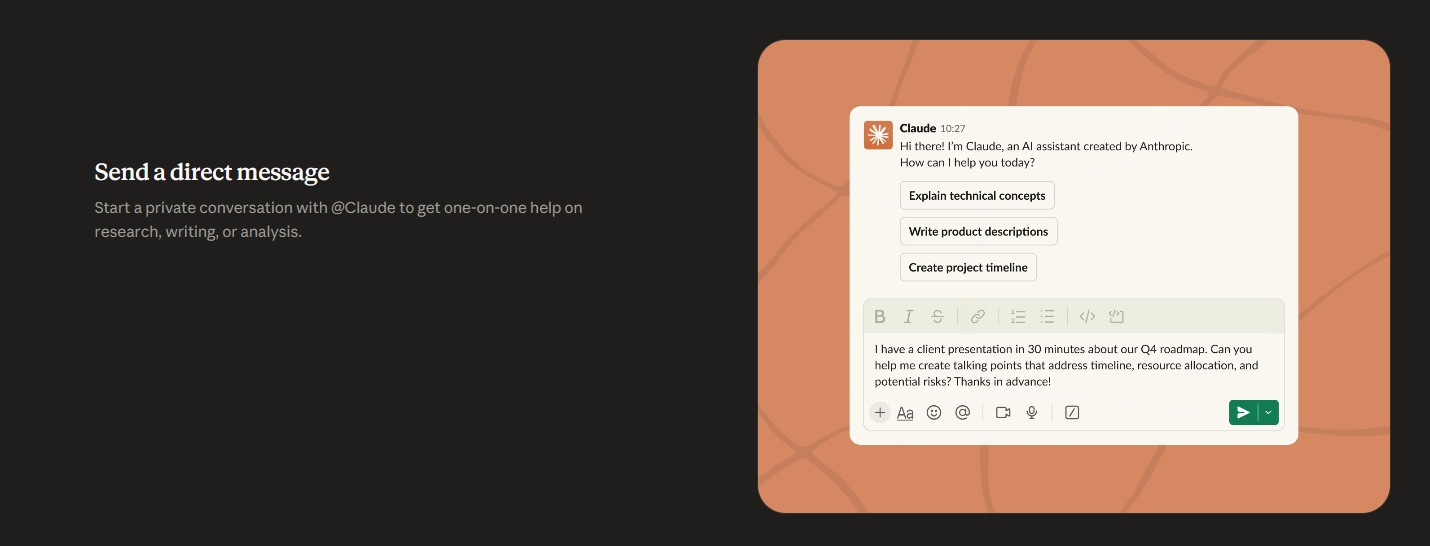
Integrating Claude directly into Slack offers immediate and tangible benefits, streamlining your workflow like never before. It brings the power of a sophisticated AI directly to where your team already communicates, eliminating context switching and boosting focus.
Consider these compelling advantages:
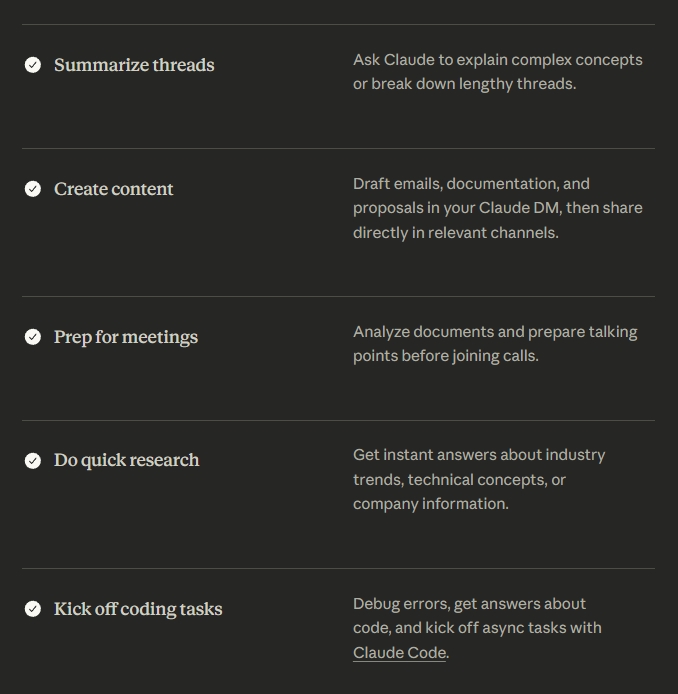
- Instant Expertise: Get rapid answers to questions, summarize lengthy discussions, or receive explanations on complex topics without leaving your channel.
- Enhanced Collaboration: Use Claude to brainstorm ideas collaboratively, draft meeting agendas, or generate creative solutions in real-time alongside your teammates.
- Task Automation: Automate repetitive writing tasks, such as drafting emails, creating social media posts, or generating code snippets, freeing up valuable human effort.
- Knowledge Amplification: Equip every team member with an intelligent assistant, democratizing access to powerful AI capabilities and fostering collective intelligence.
A Claude Slack integration ensures your team always has an intelligent partner at their fingertips, transforming conversation into action.
Official Channels to Access Claude for Slack
Accessing Claude for your Slack workspace often starts with official and supported pathways. These channels prioritize ease of use, security, and direct integration support.
The primary method typically involves looking for official applications or integrations offered directly by Anthropic, the creators of Claude. This ensures you receive the most up-to-date features and security protocols. Check the Slack App Directory for verified listings or visit Anthropic’s official website for their recommended integration methods.
Official channels often provide:
- Pre-built, certified app experiences.
- Robust documentation and support resources.
- Seamless updates and maintenance.
- Enhanced security and data privacy assurances.
Opting for an official Claude Slack integration guarantees a smooth setup and reliable performance, designed for maximum compatibility and user confidence.
Exploring Custom and Unofficial Integration Approaches
While official channels provide convenience, custom integration offers unparalleled flexibility. You might consider developing your own Claude Code For Slack bot when your team has highly specific needs not met by standard offerings.
This approach involves interacting directly with Claude’s API and Slack’s API to build a bespoke bot. You gain complete control over its functionality, triggers, and responses. For example, you could tailor it to interact with proprietary databases or integrate with other internal tools unique to your organization.
Community-driven or unofficial integrations sometimes emerge, often providing innovative solutions or early access to experimental features. However, proceed with caution: these might lack the official support, security vetting, and consistent updates found in officially sanctioned integrations. Always prioritize data security and stability when choosing your integration path.
Prerequisites for Developing a Slack Bot with Claude
Before you dive into building your custom Claude Code For Slack solution, ensure you have these essential components and knowledge in place. A solid foundation prevents common roadblocks and accelerates your development process.
You will need:
- A Slack Workspace: Access to a Slack workspace where you can create and test new apps.
- Slack Developer Account: This gives you the ability to manage your Slack apps, retrieve API tokens, and configure permissions.
- Anthropic API Key: Obtain an API key from Anthropic to access Claude’s powerful language models. This key authenticates your requests.
- Programming Proficiency: Familiarity with a programming language like Python, Node.js, or Go. These are commonly used for building bots and handling API interactions.
- Understanding of Webhooks and APIs: Grasping how webhooks facilitate real-time communication between Slack and your bot, and how APIs enable your code to talk to Claude.
Having these elements ready sets you up for a successful Slack integration project.
Step-by-Step Guide: Setting Up Your Claude Bot
Building your own Claude Code For Slack bot involves a structured process, ensuring seamless communication between your team’s chat and the AI. This high-level overview introduces the journey from a fresh idea to a functioning collaboration bot.
The core steps involve:
- Creating a new application within Slack’s developer portal. This establishes the identity of your bot.
- Defining what actions your bot can perform and what information it can access by configuring scopes and permissions.
- Setting up the communication channels, like event subscriptions and webhooks, so Slack can notify your bot when something relevant happens.
- Writing the actual program that receives messages from Slack, sends them to Claude, and then formats Claude’s replies back to Slack.
- Finally, deploying your code to a hosting environment where it can run continuously and respond to your team.
Each step is crucial for bringing your intelligent assistant to life in your Slack workspace.
Creating a New Slack App for Your Integration
Your journey begins in the Slack API dashboard. Here, you define the very foundation of your custom Claude Slack integration. Navigate to “Your Apps” and select “Create New App.” Give your application a descriptive name – something that clearly identifies its purpose for your team. This name will appear when users interact with your bot.
Next, choose the Slack workspace where you plan to develop and test your bot. This initial setup is critical; it establishes a unique identity for your bot within Slack, granting it an App ID and other credentials you’ll use throughout the development process. Think of this as giving your future collaboration bot its birth certificate and initial home.
Configuring Scopes and Permissions for Your Claude Code
Permissions are the gates to your Slack bot’s capabilities. You must clearly define what actions your Claude Code For Slack can perform and what information it can access within your workspace. Head to the “OAuth & Permissions” section in your Slack app settings.
Carefully select the necessary scopes. For a typical Claude bot, you’ll often need permissions to:
chat:writeto send messages.app_mentions:readto detect when your bot is mentioned.channels:historyorgroups:historyto read messages in specific channels (if needed for context).
Always adhere to the principle of least privilege: grant only the permissions absolutely required for your bot to function. This protects your team’s data and maintains security. After selecting scopes, reinstall the app to your workspace to apply the new permissions.
Handling Event Subscriptions and Webhooks
For your Claude Code For Slack to react to real-time events, you need to set up event subscriptions. This tells Slack where to send information when specific actions occur in your workspace. Navigate to “Event Subscriptions” in your Slack app settings.
Enable events and provide a “Request URL.” This URL is the endpoint of your server or function, ready to receive HTTP POST requests from Slack. When a relevant event happens – for example, your bot gets mentioned in a channel – Slack sends a payload of information to this URL. You must verify this URL initially by responding to Slack’s challenge request.
Specify the “Subscribe to bot events” your bot needs to listen for, such as app_mention (when someone mentions your bot) or message.channels (to listen to messages in public channels). This crucial setup ensures your collaboration bot stays informed and responsive.
Writing the Core Claude Code For Slack Interaction
With the Slack app configured, your next step is to build the brain of your bot: the code that bridges Slack and Claude. This involves two key components. First, your program must listen for and process incoming messages from your Slack workspace. Then, it needs to translate those messages into queries for Claude AI.
Once Claude provides a response, your code takes that output and formats it appropriately before sending it back to the relevant Slack channel or user. This core logic forms the intelligent loop, allowing your team chat AI to understand requests and deliver insightful replies directly where the conversation happens. Think of this as crafting the conversational pipeline.
Interacting with Anthropic’s Claude API
The heart of your Claude Code For Slack lies in its ability to communicate with Anthropic’s powerful AI. Your program will make HTTP requests to the Claude API, sending user prompts and receiving generated responses.
You will typically use a client library or directly construct web requests. Authenticate your requests using the Anthropic API key you obtained earlier. The API accepts a structured input, often containing the user’s message and contextual information. Claude then processes this input, leveraging its advanced language model to formulate a coherent and helpful reply.
Your code must handle the API response, extracting Claude’s generated text. This seamless back-and-forth ensures your Slack integration truly harnesses the full potential of Claude AI for your team’s needs.
Processing Slack Messages and Generating Responses
Your Claude Code For Slack must intelligently handle incoming Slack messages. When Slack sends an event to your webhook, your code first parses the JSON payload to extract the relevant message text, the channel ID, and the user who sent it.
You then clean this raw message, removing bot mentions or other extraneous Slack formatting. This purified text becomes the prompt for Claude AI. After sending the prompt and receiving Claude’s insightful response, your code takes over again. It formats Claude’s reply into a Slack-friendly message, potentially adding emojis, markdown, or interactive components.
Finally, your code sends this formatted response back to Slack using the Slack Web API, ensuring your team chat AI delivers clear, engaging, and contextually relevant answers directly into the conversation flow.
Deploying Your Claude Code For Slack: Hosting Solutions
Once your Claude Code For Slack functions perfectly in your development environment, the next crucial step is to deploy it. Your bot needs a reliable home, a server or service that keeps it running 24/7, ready to respond to your team’s queries. Choosing the right hosting solution impacts your bot’s performance, scalability, and maintenance.
Consider these popular options:
- Serverless Functions: Solutions like AWS Lambda, Google Cloud Functions, or Azure Functions are excellent for event-driven bots. You only pay for the compute time your bot uses, and scaling is automatic.
- Virtual Private Servers (VPS) or Dedicated Servers: For more control and consistent performance, a VPS or dedicated server gives you a stable environment to host your bot. You manage the operating system and dependencies.
- Containerization Platforms: Using Docker with services like Kubernetes, Heroku, or Google Cloud Run provides portability and easy scaling. Your bot runs in an isolated container, simplifying deployment across different environments.
Each method offers different advantages, balancing cost, control, and operational overhead. Select the solution that best fits your technical expertise and the expected usage of your Claude Slack integration.
Key Use Cases for Leveraging Claude in Slack Teams
Integrating Claude into your Slack workspace unlocks a multitude of practical applications, transforming how your team works. A Claude Code For Slack bot becomes an invaluable collaboration bot, supporting various functions and fostering greater efficiency.
Here are some powerful use cases:
- Knowledge Retrieval: Instantly get answers to company policies, project details, or technical documentation by simply asking Claude in a channel.
- Content Creation: Quickly draft emails, social media posts, blog outlines, or meeting summaries directly within Slack.
- Brainstorming & Idea Generation: Spark creativity by asking Claude for new product ideas, marketing slogans, or solutions to complex problems.
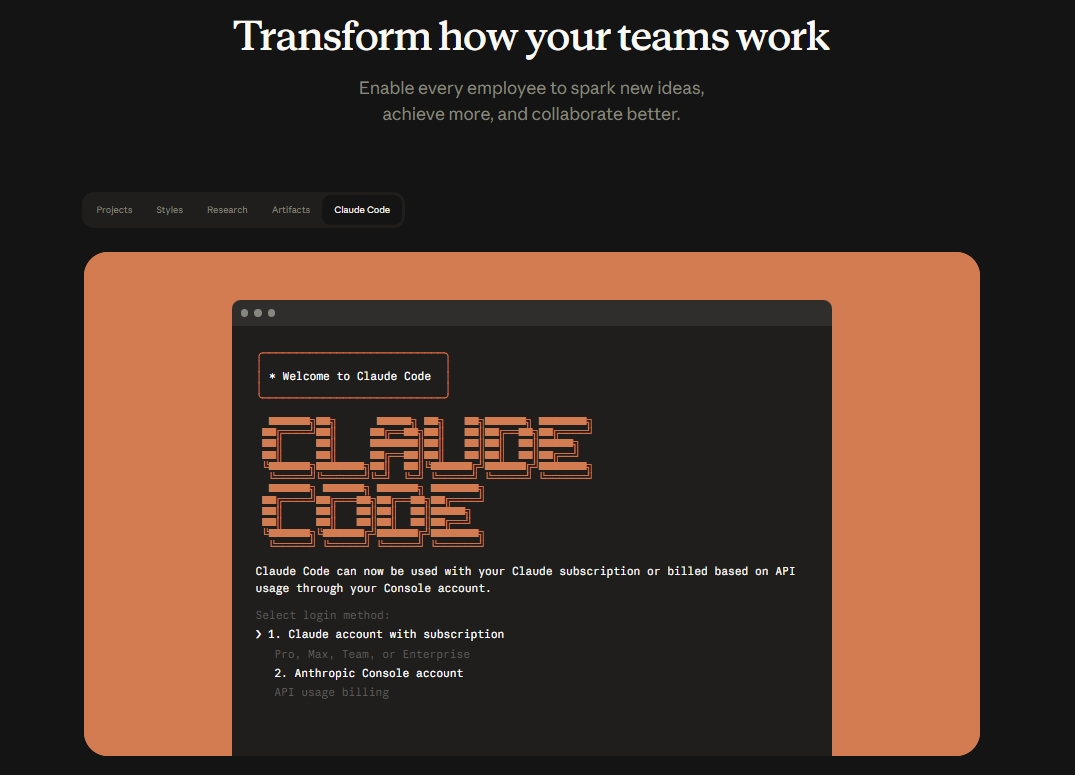
- Code Assistance: Get help with debugging, generating code snippets, or understanding complex programming concepts without leaving your development channels.
- Language Translation & Summarization: Translate messages between languages or summarize long threads and documents to save time for your team.
- Onboarding & Training: Use Claude to answer common new hire questions or explain internal tools and processes to new team members.
These examples demonstrate how a Slack integration with Claude empowers every team member with an intelligent assistant for daily tasks.
Best Practices for Team Adoption and Management
A powerful Claude Code For Slack integration is only effective if your team actively uses it. Successful adoption requires thoughtful planning and ongoing management. Here’s how to ensure your collaboration bot becomes an indispensable part of your workflow.
Start with a clear introduction. Announce the bot’s arrival, explain its purpose, and highlight key benefits. Provide simple, easy-to-follow instructions on how to interact with it. Offer training sessions or create short tutorial videos demonstrating practical use cases. Encourage early adopters and power users to share their positive experiences.
For ongoing management:
- Collect Feedback: Regularly solicit input from your team to identify areas for improvement or new features.
- Iterate & Improve: Based on feedback, update your Claude Code For Slack. This shows your team their input matters and keeps the bot relevant.
- Set Guidelines: Establish clear usage guidelines. What is the bot for? What isn’t it for? This manages expectations.
- Monitor Performance: Keep an eye on how the bot is performing, looking for common queries or potential issues.
By actively managing and evolving your Claude Slack integration, you ensure it remains a valuable asset for your team.
Troubleshooting Common Claude Integration Issues
Even the most robust Claude Code For Slack integration can encounter bumps. Knowing how to diagnose and resolve common issues quickly keeps your team chat AI running smoothly. Here are typical problems and straightforward approaches to tackle them.
- Bot Not Responding:
- Check Hosting: Is your deployment environment (e.g., serverless function, VPS) running and accessible?
- Webhook URL: Confirm your Slack app’s event subscription request URL is correct and publicly reachable.
- Error Logs: Review your bot’s server logs for any runtime errors or connection failures.
- Incorrect Responses from Claude:
- Prompt Quality: Evaluate the clarity and specificity of the prompts you’re sending to Claude.
- API Key: Verify your Anthropic API key is correct and not expired or rate-limited.
- Context Handling: Ensure your code properly sends conversation history or relevant context to Claude.
- Permission Errors:
- Slack Scopes: Double-check that your Slack app has all the necessary OAuth scopes to perform its actions (e.g., `chat:write` to send messages). Reinstall the app if you’ve recently updated permissions.
- Slow Responses:
- Network Latency: Assess network delays between Slack, your bot, and the Claude API.
- Resource Allocation: Ensure your hosting environment has sufficient resources (CPU, memory) to handle requests.
A systematic approach to troubleshooting helps maintain a reliable Claude Slack integration.
Security and Data Privacy Considerations for AI Bots
Integrating a Claude Code For Slack bot means handling sensitive team communications and potentially confidential data. Prioritizing security and data privacy is paramount to building trust and maintaining compliance. Treat your collaboration bot with the same vigilance as any critical system.
Consider these essential points:
- Data Minimization: Only process and store the absolute minimum amount of data necessary for the bot to function. Avoid unnecessary collection of personal information.
- Secure API Keys: Never hardcode API keys directly into your public codebase. Use environment variables or secure secret management services for your Anthropic API key and Slack tokens.
- Access Control: Implement robust access controls. Limit who can deploy, modify, or view logs for your bot. Use appropriate Slack permissions (scopes) – granting only what is strictly necessary.
- Encryption: Ensure all data transmitted between Slack, your bot, and Claude’s API is encrypted in transit (HTTPS/SSL). Consider encryption at rest for any data your bot stores.
- Compliance: Understand and adhere to relevant data protection regulations (e.g., GDPR, CCPA) that apply to your organization and user data.
- Regular Audits: Periodically review your bot’s code, logs, and configurations for potential vulnerabilities.
A proactive approach to security ensures your Slack integration remains safe and trustworthy.
Customizing Claude’s Responses and Functionality
While Claude AI provides impressive capabilities out of the box, tailoring its responses and extending its functionality can make your Claude Code For Slack truly unique and invaluable to your team. Customization transforms a general-purpose AI into a specialized collaboration bot.
You can achieve this through various methods:
- System Prompts: Provide Claude with a “system message” at the start of each conversation. This instructs it on its persona, tone, and specific rules it should follow. For example, instruct it to act as a “marketing expert” or a “concise summarizer.”
- Few-Shot Learning: Include examples within your prompts. Show Claude a few input-output pairs that demonstrate the desired response style or format. This guides its generation more effectively.
- Tool Use (Function Calling): Integrate Claude with external tools or databases. Your Claude Code For Slack can detect when Claude suggests calling a specific function (e.g., “look up sales data”) and then execute that function, feeding the results back to Claude for further processing.
- Pre-processing and Post-processing: Before sending a message to Claude, your bot can add context, filter irrelevant parts, or inject specific instructions. After receiving Claude’s response, your bot can reformat it, add custom buttons, or filter out undesirable content before posting to Slack.
These techniques empower you to finely tune your Claude Slack integration to meet your exact team needs.
Comparing Claude Integration with Other AI Tools in Slack
The landscape of AI tools in Slack is vibrant, but Claude Code For Slack stands out with its distinct advantages. When considering a collaboration bot, understanding these differentiators helps you make the best choice for your team.
Claude is renowned for its:
- Advanced Reasoning: It excels at complex analytical tasks and nuanced understanding, often delivering more sophisticated and contextually aware responses.
- Extended Context Window: Claude can process and remember much longer conversations, allowing for deeper, more sustained discussions without losing track of previous points. This is crucial for long-running projects or detailed brainstorming sessions.
- Safety and Alignment Focus: Claude is built with a strong emphasis on being helpful, harmless, and honest. This commitment results in more reliable and ethically sound outputs, reducing the risk of undesirable or biased responses.
- Transparency in AI: Anthropic’s approach often provides clearer insights into Claude’s capabilities and limitations, fostering greater trust and predictability in its Slack integration.
While other AI tools offer speed or specific niche features, Claude’s robust capabilities in reasoning, context retention, and ethical AI development position it as a top-tier choice for comprehensive team chat AI.
The Future of AI-Powered Communication in Workspaces
The integration of AI like Claude Code For Slack is just the beginning. The future of communication in workspaces promises even more profound shifts, making teams more agile, informed, and innovative. Your collaboration bot will evolve beyond simple question-answering.
Imagine:
- Proactive AI Assistants: Bots will anticipate needs, suggesting information or initiating tasks before you even ask, based on project context and deadlines.
- Seamless Multimodality: AI will effortlessly understand and generate responses across text, images, and even voice within your team chat AI environment.
- Hyper-Personalized Experiences: AI will learn individual preferences and working styles, tailoring its interactions to optimize each team member’s productivity.
- Autonomous Workflows: Complex tasks currently requiring human oversight will be delegated to AI, from drafting entire reports to orchestrating project updates across multiple tools.
This evolution means a Slack integration will become not just a tool, but an intelligent layer embedded deeply into every aspect of organizational communication, constantly adapting and enhancing human potential.
Frequently Asked Questions
What are Claude AI’s key capabilities for businesses?
Claude AI excels at complex reasoning, robust language understanding, and nuanced interaction. It can handle tasks from drafting reports to brainstorming campaigns, processing extensive context, and providing reliable, trustworthy outputs due to its focus on helpful, harmless, and honest interactions.
What are the primary benefits of integrating Claude directly into Slack?
Integrating Claude with Slack offers instant expertise for rapid answers, enhanced collaboration for brainstorming, task automation for repetitive writing, and knowledge amplification by democratizing AI access, all while eliminating context switching and boosting focus.
What prerequisites are needed to develop a custom Claude Slack bot?
To develop a custom Claude Slack bot, you need a Slack Workspace, a Slack Developer Account, an Anthropic API Key, proficiency in a programming language like Python or Node.js, and an understanding of webhooks and APIs.
Can you provide examples of how Claude can be used in Slack teams?
Claude in Slack teams can be used for knowledge retrieval (company policies), content creation (emails, outlines), brainstorming, code assistance (debugging, snippets), language translation/summarization, and onboarding/training new team members.
What distinguishes Claude from other AI tools in Slack?
Claude is distinguished by its advanced reasoning, extended context window (allowing longer conversations), strong emphasis on safety and alignment (helpful, harmless, honest outputs), and Anthropic’s commitment to transparency, making it a top-tier choice for comprehensive team chat AI.